
Web Desk (LTN NEWS): People who have been forced to leave their homes in Sindh are already stuck in stagnant rainwater, and now diseases and skin infections are spreading.
This is because the conditions are not clean and the water is dirty.
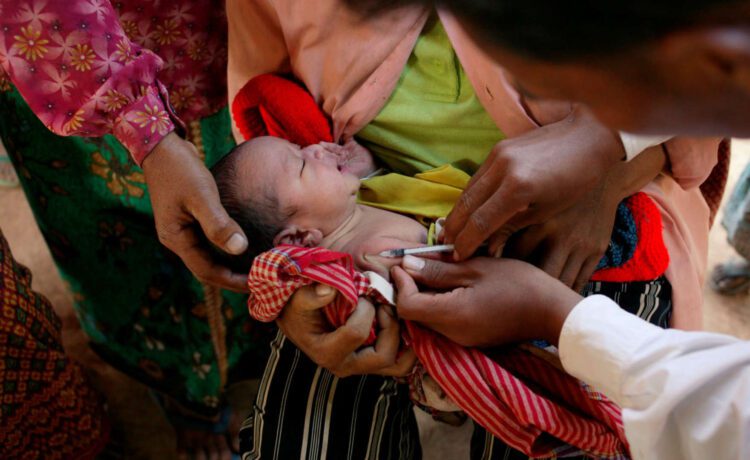
Experts in health care say that children, women, and older people are at risk of getting diseases like malaria, dengue, typhoid, diarrhea, and skin infections.
People who are helpless, homeless, and sad complain that there aren’t any nearby medical camps or immediate health aid for them.
Khan Muhammad Khaskheli, who lives in Nehal Khan Khorkhani in the Khairpur district, said, “Every other person is sick.” “I see people who are helpless and crazy,” he said. “There are no medical facilities for the poor, and those who can move their loved ones to the cities,” he said.
Khaskheli said that one of his relatives was in terrible pain all night but couldn’t get help because he was too far away.
“The next day, he was moved to the hospital,” he said.
There are 2,257 health facilities in Sindh, but health officials say that only 200 of them are working because water has been sitting in the buildings.
“All are actually working because the staff has been told to set up camps in the damaged hospitals,” said Dr. Juman Bahooto, who is in charge of the Sindh Health Services.
But the victims show that this is not true.
Rabail Siyal, who lives in the village of Pathan in the district of Larkana, said, “I don’t see anyone getting medical help.”
“The government is just putting on a show. They can’t help the people and, unfortunately, they can’t even take help,” he said.
Experts in health care say that the government wasn’t able to handle the situation at all.
“No one was ready for this challenge, and our system doesn’t have the capacity to deal with it,” said Dr. Abdul Ghafoor Shoro, General Secretary of the Pakistan Medical Association (PMA) Karachi Chapter.
He also said that dozens of volunteer groups and other groups had set up medical camps all over Sindh. “It proves that there is no government in place,” he said. “More than 80% of patients were found to have malaria because mosquitoes were there,” he said.
Dr. Shoro said that the current emergency had shown how weak the government’s system for primary health care was.
“The government should ask for help from international health groups because the situation will get out of hand in the next few days,” he warned.
People who had to move have been drinking dirty water and eating food that wasn’t cooked right.
The health department says that in the last two weeks, they have set up more than 4,500 mobile and permanent medical camps. “We usually run at least 500 medical camps, and sometimes up to 800,” said Dr. Bahooto, who is in charge of health services for the province.
The government official also told The Express Tribune that most of the people who went to hospitals and medical camps had a fever (malaria and dengue), diarrhea, and skin diseases.
“It’s because they use water that isn’t clean. We have already told people to use water that has been boiled,” he said.
Dr. Bahooto did not agree that there was a shortage of medicines in any area, but sources in the health department told The Express Tribune that the load on regular OPDs had increased by about 40 times. “We’re going to run out of medicine in a few days,” a high-ranking official said.
Even though the health department made big claims, families who had to move and people who lived in faraway places said that its teams had not been to their areas.
Dadu, Qamber-Shahdadkot, Jamshoro, Badin, and parts of the Mirpurkhas division are the places most affected.
“Yes, it is still hard to get to places that don’t have roads,” said Riaz Hussain Rahojo, who runs the People’s Primary Healthcare Initiative (PPHI).
“It hasn’t rained in two days, but it will take us a few more days to reach everyone,” he told The Express Tribune.
Rahojo said that his organization was taking care of 1,300 health facilities and that all of them were open and working at all times.
“OPDs have a huge amount of work to do these days, and we all look at it as a challenge,” he said.