

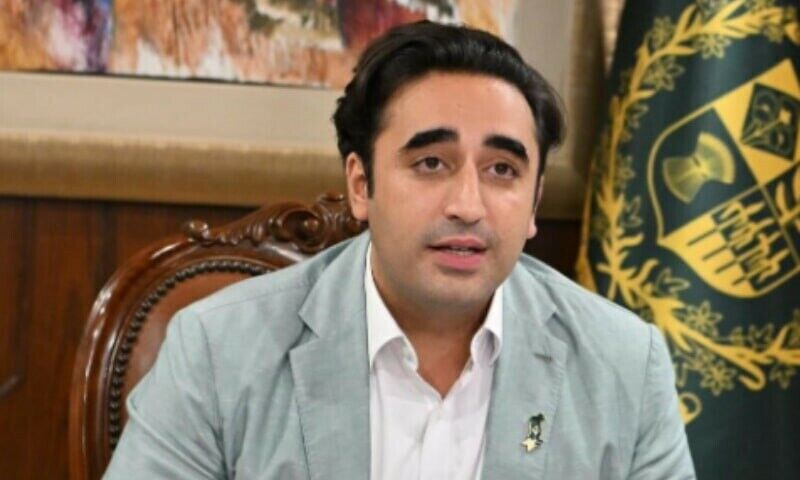
Web Desk(LTN News): According to Foreign Minister Bilawal Bhutto-Zardari, rather than contributing to escalating tensions or “becoming a geopolitical football,” Pakistan should serve as a link between China and the United States.
The foreign minister made these statements in response to queries on Islamabad’s relations with Washington and Beijing during an interview with Foreign Policy, particularly in relation to aid pledged and delivered by the two in the wake of catastrophic floods.
“What China does is entirely up to China, whether it has to do with Pakistan or Sri Lanka. In response to Foreign Policy’s Ravi Agarwal pointing out that Beijing “hasn’t quite come to Pakistan’s aid in a big way” following this year’s catastrophic floods and that even Sri Lanka wasn’t able to get much help from China in the wake of an economic crisis, he said, “just like it’s 100 percent America’s decision in either of these circumstances.”
Bilawal continued, “I would like Pakistan to continue to play a role that we have in the past, rather than being a point of competition or a venue for these divisions (between China and the US) to be aggravated. Pakistan served as a conduit between China and the US at first, which led to the establishment of diplomatic ties between them.
“And right now, particularly when we’re drowning in floods, I don’t want to play any part in exacerbating any tensions or being a geopolitical football.
“In this time of great geopolitical division, I would much rather play the role of a bridge by uniting these two great powers around working together for climate change.”
Perhaps Pakistan’s unusual status as a friend of both the US and China could inspire collaboration on this front, the foreign minister suggested.
The timing of Bilawal’s comments coincides with a verbal battle between China and the US over aid to Pakistan for debt reduction and flood relief to help it deal with the effects of this year’s torrential rains.
US State Secretary Antony Blinken urged Pakistan on Monday to ask China for debt assistance while emphasizing Washington’s support for Islamabad during these difficult times.
‘Flood response fantastic, but a drop in the ocean
Bilawal also discussed the international aid that Pakistan has so far gotten to deal with the devastating floods in a broader context, calling the reaction to aid calls from outside “wonderful” but a “drop in the ocean” in comparison to what the nation required.
“We’re still in the initial rescue-and-relief phase, and we’re conducting our damage needs assessment. So far, we’ve only launched flash appeals, to which we’ve had a fantastic response — not only the United States contribution of around $60 million but from all of our friends,” he said.
“Isn’t that just a drop in the ocean, so to speak?” Agarwal asked back, to which Bilawal replied, “It’s all a drop in the ocean compared to what we need”.
He added that after the assessment of the amount needed to cover the loss caused by floods, Pakistan would be in a better place to understand the total damage.
“At the moment, it’s just a guesstimate, which puts the total damage at $30 billion.”
Bilawal went on to call his journey to the US, during which he spoke at numerous events and attended the 77th session of the UNGA, “good.”
He thanked UN Secretary-General António Guterres for visiting Pakistan before the UNGA meeting and “successfully focused a lot of those sessions into talking about climate — in particular Pakistan’s floods.” “We’ve been able to convey the hardship of our country,” he said.
When previously questioned about the likelihood of the Green Marshall Plan making headway at the upcoming COP27 summit, Bilawal responded, “I don’t think that hopes have been dashed that we should stop trying.
“I have discussed climate justice, and rather than viewing it as a contradiction, I would see it as a continuation of the stated position of the US president and the leaders of many countries in Europe that we need to invest and gather the funds not only for domestic climate adaptation but also for international adaptation.
“And within that context, I proposed a Green Marshall Plan for climate-stressed countries, all of which contribute negligibly to the global carbon funds.”
When asked about the plan’s funding, Bilawal responded, “The huge polluters who have brought about this disaster.”
He emphasized the necessity for novel approaches to the climate challenge, citing “the concept of a debt swap for climate, where countries that owe a debt to the great polluters would swap this debt” as one such approach.
The business sector would need to be encouraged to invest in climate adaptation, he added, and the suggested answer would not solely be in the state sector.
“I believe that the public-private partnership model could be adopted not only for green energy but also for green infrastructure.”
Later on in the interview, Agarwal questioned Bilawal on if Pakistan was receiving or anticipating assistance from India to deal with the damage brought on by the floods.
Both questions received a negative response from Bilawal.
Agarwal then questioned him, asking what he would say if he could address the Indian foreign minister or the Indian audience.
“If I could say something to you, I wouldn’t. Look, this is their decision and their stance, Bilawal said.
The journalist next questioned the foreign minister on whether he had requested assistance to deal with the flood damage.
“No, to be honest. I haven’t asked anyone. I didn’t ask for help from the US — they volunteered it. Didn’t ask for help from China — they volunteered. Didn’t ask for help from the Middle East — they volunteered,” Bilawal said.
“In times of human catastrophe, I think it tests everyone’s humanity.”
“More comfortable with our relationship with US today
Agarwal made similarities between the aid offered by Washington during the devastating floods of 2010 and those of 2022 when discussing Pakistan’s relations with the US and how they have changed over time.
“US aid is now only a small portion of what it once was. Do you find it concerning that Pakistan’s relationship with America has changed? He queried.
In response, Bilawal said, “No, in fact, I’m much more at ease with our relationship with America today than I was in 2010. I believe that people just saw us through the lens of Afghanistan and hyphenated us as “Af-Pak.”
He went on to say that since Islamabad had resumed contact with the US State Department and the US government, “our trade relations have been the subject of a more widespread discourse.”
“But to be realistic, we have to understand that the world has changed. It’s not just Pakistan or the US that has changed. We’ve seen a once-in-a-lifetime pandemic. We’ve seen the fall of Kabul. We’ve seen the Ukraine crisis.
“It’s a very different economic space. And a lot of money is being spent domestically and on other international issues. I’m very cognisant that everyone is dealing with domestic economic challenges.”
Agarwal questioned Bilawal on the extent of cooperation Pakistan had given the US in the assassination of Al-Qaeda leader Ayman al-Zawahiri in a US strike in Afghanistan last month, referring to the mention of Afghanistan in Bilawal’s response.
In response, Bilawal said, “I mean, it wasn’t in our country or in our awareness that this person was there or that there was an operation to remove him out.
Agarwal went on to inquire precisely if Pakistan had allowed the US to use its airspace for the drone strike.
“No. We were unaware of this, as I previously stated. I don’t believe anyone was, Bilawal affirmed.









Can you be more specific about the content of your article? After reading it, I still have some doubts. Hope you can help me. https://accounts.binance.com/uk-UA/register-person?ref=XZNNWTW7