

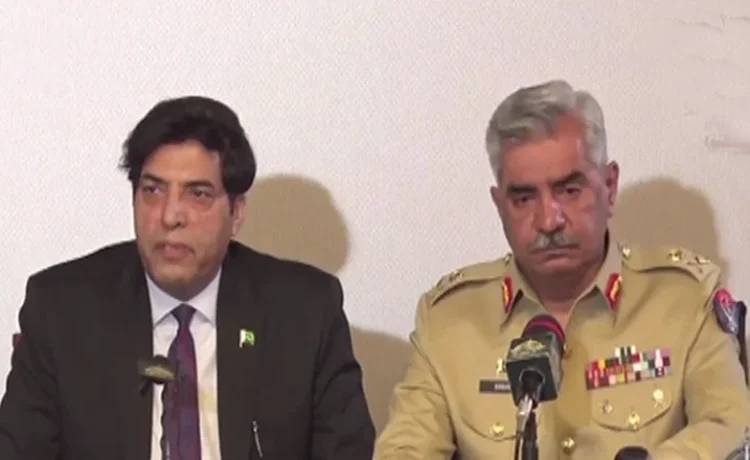
Web Desk (LTN NEWS): Inter-Services Intelligence chief Lt Gen Nadeem Ahmed Anjum joined Inter-Services Public Relations (ISPR) DG Major General Babar Iftikhar at an explosive and unexpected press conference to talk about the killing of journalist Arshad Sharif and former Prime Minister Imran Khan’s confrontational comments about the military, among other things.
This is the first time in Pakistan’s history that the head of the country’s spy agency has talked directly to the media.
Gen Iftikhar said at the start of the press conference that the goal of today’s media talk was to explain why journalist Arshad Sharif was killed in Kenya and what led up to it.
This press conference is being held so that “facts, fiction, and opinion can be separated,” he said. He also said that Prime Minister Shehbaz Sharif had been “specially told” about how important the press conference was.
He also said that it was important to figure out why a certain story was being told and why people were misled by it.
“Gen Qamar Javed Bajwa, who is the Chief of Army Staff (COAS), was also criticized. There was an attempt to cause a split in society.”
He called Sharif’s death a “tragic event” and said he was “an icon of journalism in Pakistan.” He said some of the late journalist’s family members had been in the army. He also said he always felt bad for officers who died on duty.
Cypher
Gen Iftikhar went on to say that Sharif’s popularity came from being an investigative journalist. When the cypher came out, which PTI leader Imran Khan said was proof of a foreign plot to get rid of his government, he did several shows about it.
The DG ISPR said he met with the former prime minister several times and talked to him. “As a result, it was said that he was shown the cypher and the meeting minutes.”
Read PTI sends show cause notice to Faisal Vawda; cancels his membership
He said that the truth needs to be found out about the cypher and Sharif’s death.
Gen Iftikhar said that the army chief had talked to Imran about the cypher on March 11, when Imran said that it was “not a big thing.”
“We were surprised when, on March 27, a piece of paper was waved and someone tried to make up a story that was very different from the truth.”
He said that several facts about the cypher had come to light, showing that the “baseless and unfounded” story about it was false. He said that the ISPR told the National Security Committee that there was no proof of the plot against the PTI government. He also said that the Inter-Services Intelligence (ISI) did not find any proof of the plot.
“All of this is written down. We wanted people to know about this. And we left the choice up to the government at the time.”
However, this did not happen, and more rumors were spread to help politicians; he added that the Pakistan Army was also a target.
Sharif and other journalists were told a certain story at this time, and he said there was an attempt to make Pakistan and its institutions look bad around the world.
Gen Iftikhar said that the army expected to get involved in politics at home. “The words politically neutral were used in a bad way. In response to these untrue stories, the army chief and the institution were calm, and we did everything we could to get politicians to work together to solve their problems.”
During this time, Sharif said some harsh things about the army, but he added, “We didn’t have any bad feelings about him then, and we don’t have them now.”
In his first public appearance, DG ISI said that COAS made a lucrative offer for an extension in March.
Today, for the first time in Pakistan’s history, the head of the ISI also showed up at a press conference.
“I know you’re surprised to see me,” he said.
“But I’m here for my institution and for the officers who are giving their lives.”
“As head of this agency, I can’t stay quiet when people are picked on for no reason.”
Lt. Gen Anjum said that the country had given him the job of keeping secrets until he died. “But I will bring those facts to light when and when I need to.”
He added that the officers who were killed in Lasbela were laughed at. So, he said, it is very wrong to say things without proof. He also said that “neutral” and “janwar” were used to show that the institution was causing trouble.
He also said that these words were used because the institution would not give in to an “illegal and unconstitutional act.”
“Last year, the establishment decided to stick to what it was supposed to do under the law. After a long discussion, the army came to the conclusion that it would be best for the country if we stuck to our constitutional roles and stayed out of politics.”
He said there was much pressure in March, but the institution and the head of the army decided to keep the military from doing things that were not in the Constitution.
He said that Gen Bajwa could have spent his last few months in office in comfort, but he did not because he thought it was best for the country, adding that the army chief’s family was also a target.
Lt Gen Anjum also said that in March, Gen Bajwa was given a lucrative offer to stay in his job for longer.
“I watched as it was made. He said no because he wanted the institution to move from a role that was controversial to a role that was based on the Constitution.”
The head of the ISI seemed to be talking about former Prime Minister Imran when he said, “If he was a traitor, why did you praise him so much in the past?”
“Why do you meet him through the back door if you think he is a traitor? […] Don’t do this, where you meet quietly at night through the back door and say things that are against the Constitution, but in the middle of the day you call the army chief a traitor. That’s a big difference between what you say and what you do.”
Later, when asked who gave the COAS the extension, he said it was obvious that the government was in power at the time.
“The offer was made because the vote of no confidence was at its highest point,” he said.
“Pakistan is a democratic country, and its democratically elected government is in charge of deciding who its friends and foes are. The institution’s job is to show what they think based on the information they have. The government will make the decision.”
He went on to say that politics based on hate led to instability and that this caused people to be divided.
The head of ISI said that when he was hired, he was asked what the most important problem in the country was.
“I said it was because of our bad economy, but the person who asked did not agree. They thought that the biggest problem was the other side.”
Intolerance in politics leads to instability
He said that intolerance in politics leads to instability and that constitutional and legal ways should be considered. When we use the back door, it makes the country a mess.
Lt. Gen Anjum said that his decision to show up at today’s press conference was to protect the country’s institutions.
“I would often see lies being told, and the young people would believe them. I didn’t show up because I had other things to do. I saw how lies were putting the country and its institutions in danger, so I spoke up.”
Later, during the press conference, he said he was not there for personal reasons.
“In March, people used social media to try to get rid of me. I was told by the agency that there was a campaign against me. I told them to get in touch when the number of retweets went over 8,000,000,000. I didn’t care about myself before that.”
He said that he would have talked to the media earlier if it were about himself.
“They shouldn’t have to deal with these lies after giving their lives. So, I thought it was morally wrong for me to keep quiet.”
Sharif was a competent, hardworking, and skilled journalist
The head of the ISI said that Sharif was a competent, hardworking, and skilled journalist. Some people may not agree with his political views, but no one can deny how hard he works.
However, he said Sharif was not in danger in Pakistan, based on what he had heard. Lt Gen Anjum said that Sharif’s family included officers who died in the line of duty and that the journalist had connections with the establishment.
“Even after he left the country, he kept in touch with [the establishment].”
The DG ISI said he talked to his Kenyan counterpart about the investigation. He also said that preliminary investigations showed that it was a case of mistaken identity.
Maybe the government nor we are fully sure. So, the government has put together a group that will go to Kenya.
He then said that intelligence officers had been taken off the investigation teams so that a fair investigation could be done. “The DG ISPR will let you know the result, no matter what it is.
When asked about the threats from the ISI to the journalist, he said again that Sharif had good contacts with his subordinates. He also said that the journalist would not be able to leave the country if the government did not want him to.
We did not dislike him as a person. He knew some of our officers from before. Even more, journalists say they get calls. This is not true. He also said that apps let the person making the call hide their identity.






Reading your article helped me a lot and I agree with you. But I still have some doubts, can you clarify for me? I’ll keep an eye out for your answers. https://www.binance.info/lv/register?ref=SMUBFN5I