

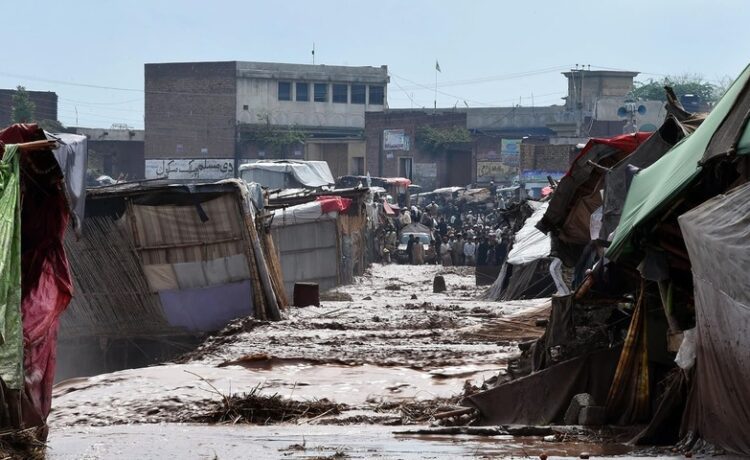
Web Desk (LTN NEWS): Since August 25, flash floods have destroyed more than 490 homes, 50 hotels, 40 schools, 54 bridges, link roads, 200 riverbank spurs, and many vehicles in the Hazara and Malakand divisions of Khyber Pakhtunkhwa.
In the last three days, the flood in Swat destroyed 233 homes, 41 schools, 50 hotels, and 24 bridges, according to the district’s government.
Officials say that 130 kilometers of roads in the district were also destroyed by the floodwaters.
They said that more than 1,000 tourists who were stuck in the areas of Kalam and Bahrain were being taken to safety by helicopter.
Many people who were stuck in rivers were saved.
The officials also said that the district’s government had started to fix things up. Teams were draining floodwaters and vaccinating animals against diseases, they said.
Arshad Khan, who is in charge of information, said that about 10 tons of food had been sent to the people in the district.
Residents of Kalam worried about more flooding
The Frontier Works Organization said that it was working to clear the part of the Karakoram Highway that was blocked in the Mansehra district so that traffic could go back to normal between Khyber Pakhtunkhwa and Gilgit-Baltistan.
People in disaster-stricken Manoor, Mahandri and other parts of the Kaghan valley were upset that relief work hadn’t started yet.
The government of Lower Dir said that the damaged part of the Timergara Peshawar Road in the Zulam area was fixed before small vehicles could use it again. It said that heavy machinery was used to fill the riverbank with rocks.
Rescue 1122 workers also saved the lives of three people who were trapped in a building on the bank of the Panjkora River in the Zwall Baba area and a man who was stuck in the Kunai stream in the Takatak area of Lower Dir.
Rescue 1122’s Abdur Rehman said that in the last two days, the group had saved 20 people from the flooded Talash stream, three people from the Panjkora River in the Zwal Baba area, one person from the Maidan stream, 12 people from a private hostel in Timergara, a teacher and three students from a private college in Timergara, and 10 bodies, seven of which were children, two of which were women, and one of which was a man, from
Two people who were stuck in the Kurrum River in Bannu were rescued by the district administration. It said that the two men got stuck in the river for four hours while trying to cross it to get wood for a fire.
The two men were moved to a safe place by the rescue team, which was led by Assistant Commissioner Syed Abrar Ali Shah.
Shakil Ahmad, an assistant commissioner in Lakki Marwat, gave a flood-affected family in Betanni tribal subdivision, where a young male child had died in flash floods, a check for compensation. He also gave them food and things that weren’t food.
The AC said that a detailed survey was being done in the area to figure out how much damage was caused by the floods and make a full report so that victims could get their money quickly.
He also said that the government had moved nine families into government buildings and given them food and other things.
Meanwhile, 90 people who were stuck in the middle of the Indus River in the Hund area were saved, said Swabi deputy commissioner retired Captain Sanaullah in a social media post on Saturday.
He said that among the people who were stuck were old people, children, and women.
The DC said there was a lot of water in the Kabul River and that many families had to leave their homes because they were afraid the water level would rise.
The Elementary and Secondary Education Minister, Shahram Khan Tarakai, has been chosen by Chief Minister Mahmood Khan to be the government’s point person for relief efforts in the district.
Also on the same day, the leader of Jamiat Ulema-i-Islam-Fazl, Maulana Fazlur Rehman, asked the right people to get people stuck in flood-hit areas out of there quickly and give them aid.
He also asked people to give money and goods to help the people who had been hurt by the disaster.
During a visit to flood-damaged areas in the Dera Ismail Khan district, including Yarik, Muqeem Shah, Pusha Bridge, and others, the head of the JUI-F said that the provincial and central governments should work together and use all available resources and government machinery to help families affected by flash floods.
At the same time, Ahmed Karim Khan Kundi, the deputy leader of the PPP in the Khyber Pakhtunkhwa Assembly, helped with relief and rescue efforts in Budh village, which was the worst hit by flash floods.
A warning from the National Disaster Management Authority (NDMA) said that the River Kabul at Nowshera will continue to flood at a very high level for the next 24 to 48 hours. At the same time, the River Indus at Chashma is likely to reach a high to very high flood level.
On Saturday night, the water levels in the River Kabul in the Nowshera district were still high, but the water flow had gone down a little bit. On the other hand, even though the flow of water from the River Swat had slowed down a lot by evening, many parts of the district of Charsadda were still under water. But there were no deaths in either district.
On Friday night, the Munda headworks, which control the flow of the River Swat near the village of Abazai, broke. This caused panic in the area. At least 18 villages were flooded in Charsadda. Some of these were Nisatta, Parang, Tarnab, Hisar, Yasinzai, Agra, and Paidakhel. But by Saturday night, the flow from the headworks had dropped from about 260,000 cusecs on Friday night to 84,000 cusecs.
The district administration for Charsadda said that only a few thousand of the 185,000 people who had to leave their homes were staying in camps. The rest were staying with their families.
People who had to leave their homes because of floods caused by heavy monsoon rains in KP’s Charsadda district on Saturday took refuge along a highway. — AFP
On the other hand, the district government of Nowshera said that between 150,000 and 185,000 people were moved from low-lying areas to safer places.
A lot of the district was still flooded, including Mohib Banda, Pir Sabaq, Pashtun Ghari, Banda Sheikh Ismail, and Khesghi.
The Pakhtunkhwa Energy Development Organization said that its 17-megawatt Ranolia power station and the 36.7-megawatt Daral Khawar power station in Swat were both badly damaged.
Wapda officials say that the raging waters of the River Swat also broke through the protection dyke around the diversion tunnel of the Mohmand Dam, which is still being built, a few kilometers upstream of the Munda headworks. This slowed down construction work.
In the Kalam area of Swat, two small hydroelectric power plants were also washed away.
Balochistan
Sources said that nine bodies, including three children, of people who died in flash floods, were found in Pishin, Dear Bugti, Hanna Orak, Mastung, and Chashma Achozai.
Killi Nasaran, a neighborhood on the edge of Quetta, was hit hard when the Spine Karez flooded near Quetta Cantonment and washed away more than 250 mud houses, leaving 300 families without a home. Officials said that the displaced people were moved to Police Lines.
Officials said that three dams in Ziarat broke, including the Kech, Pechee, and Kawas dams. The road that connected Ziarat to Quetta and other places was also washed away.
In the districts of Pishin, Mastung, and Bolan, three dams were damaged when they overflowed after they were filled to their full capacity.
Seasonal rivers also overflowed in Sibi, flooding many places in the town and near its edges.
In Bolan district, things weren’t much better. After a 150-year-old railroad bridge was destroyed, the Bibi Nani Bridge was damaged, and another bridge on the road between Quetta and Sukkur was washed away.
The Lehri River also caused huge floods in Nasirabad, Sohbatpur, Jaffarabad, and Jhal Magsi. “There is four to five feet of flood water around Dera Murad Jamali, Dera Allahyar, and Sohbatpur.”
Officials said on Saturday that the road between Quetta and Karachi was open again.
This report was also helped by Khalid Hasnain in Lahore, Faiz Muhammad in Charsadda, and Nisar Ahmed Khan in Manshera.