
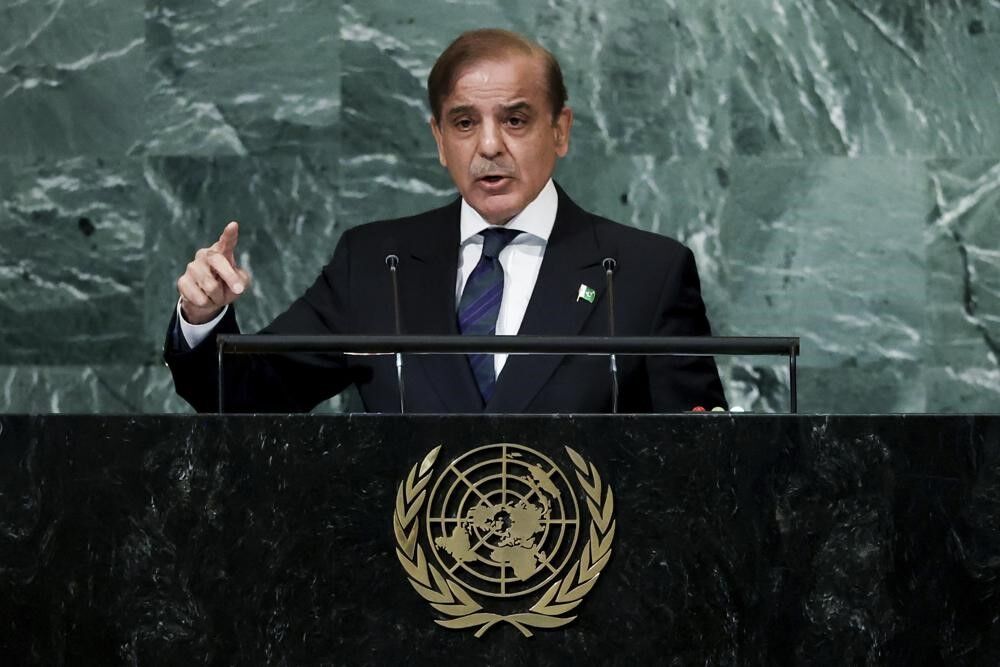
Web Desk (LTN NEWS): Pakistani PM Muhammad Shehbaz Sharif stated that his country’s economy and people were bearing the double burden of climate injustice and rising global warming, which had resulted in terrible floods, and that the world’s leaders needed to take prompt corrective efforts.
“It is time we paused from the concerns of the 20th century and turned our attention back to the problems of the 21st. If international leaders don’t act immediately behind a minimum agreed-upon agenda, there won’t be a planet left to fight over, and that fundamentally alters the meaning of national security.”
PM Shehbaz warned the 77th session of the United Nations General Assembly that nature would be fighting back and that humanity would be helpless to stop it.
“As I take the stage here today to share the tale of Pakistan, my thoughts and feelings have been rooted in my homeland the entire time. The shock we’re under and the way the country’s face has changed beyond recognition is beyond description.”
As he continued, “I have come here to convey first hand, the enormity and magnitude of this climatic calamity that has thrown one-third of my country underwater in a super storm no one has seen in living memory.”
According to PM Shehbaz, a biblical flood deluged us for 40 days and 40 nights, shattering centuries worth of meteorological records and testing our understanding of tragedy and how to respond to it.
Read EU President assures help to flood victim’s
Huge swaths of the country are still underwater, lost in a sea of human agony. With 650,000 women giving birth under improvised tarps, this climate change epicenter is home to 33 million people, many of whom are vulnerable due to the effects of climate change.
Over 400 children, out of a total population of 1500, perished in the big flood. Disease and starvation threaten the lives of even more people. “As we speak, millions of climate migrants are still hunting for a dry place to pitch their tents on, having suffered devastating losses to their families, futures, and livelihoods,” he continued.
A million homes have been destroyed and another million have been damaged, the Prime Minister said, citing preliminary estimates. More than 13,000 kilometers of metalled highways were reportedly damaged, and more than 370 bridges were washed away.
There have been almost a million agricultural animals lost. Damage of an unprecedented magnitude has been caused, he said, and four million acres of crops have been lost, depriving the population of their main source of nutrition.
PM Shehbaz explained to the UN that accelerating economic growth and rescuing millions of people from poverty and hunger were Pakistan’s highest priorities right now. He also noted that Pakistan needs an externally stable environment in order to gain any policy momentum.
Prime Minister Shehbaz Sharif claimed that Pakistan had never seen more dramatic and terrible evidence of the impact of Global Warming. He continued, “Life in Pakistan has changed permanently.”
As a result of the disaster, I have seen and spent time in every region of my country. The people of Pakistan want to know why they are suffering this fate. He said, “When global warming rips apart whole families and an entire country at this savage speed, it is time to ask why and time to ask not what can be done but what MUST be done.”
“The plain and inconvenient fact is that this tragedy has not been provoked by anything we have done,” the prime minister stated. There has been rapid melting of our glaciers, widespread fires in our woods, and temperature spikes above 53 degrees Celsius, making our world the warmest on record.
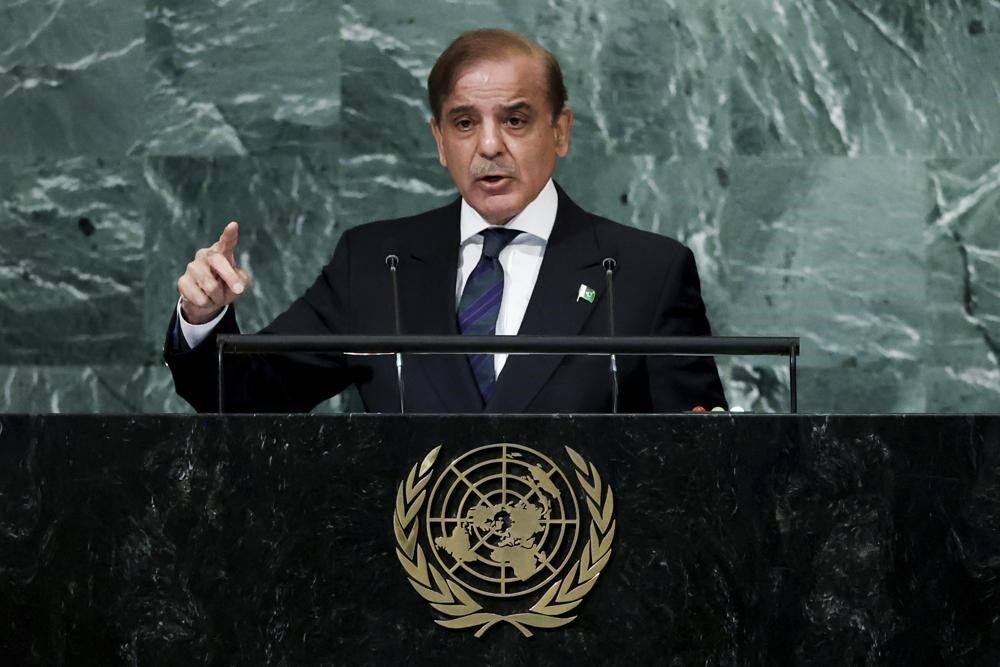
PM Shehbaz quoted the UN Secretary-General as frankly admitting that “hotspots like Pakistan fall in the ten most climate-vulnerable list of countries, but release less than one percent of the greenhouse gases that are destroying our planet.
As a result, it is quite realistic to anticipate restitution for the losses and damages incurred, together with the possibility of constructing a stronger, more resilient replacement. It’s very clear that now is not the time for deliberation over how to proceed.
Read World must show support to flood victims: PM Shehbaz
PM Shehbaz expressed gratitude to UN Secretary-General Antonio Guterres for his visit to Pakistan and time spent with climate refugees, including mothers and children living in tents.
Now is the time to express gratitude to all the nations who have sent aid and representatives to Pakistan to show support during this difficult time. Again, on behalf of my country, I offer my deepest gratitude to each and every one of them,” he continued.
PM Shehbaz stated that the next stage of this problem was causing him the most concern because the effects on his country’s health and prosperity were beyond estimation at this point.
He wondered aloud, “Will we be left alone, to cope with a situation we did not create when the cameras depart, and the coverage just shifts away to wars like Ukraine?”
The rescue and relief work has been ongoing for 12 weeks; the question now is, “Where and how can we begin to repair and reconstruct?” Many of the lives we have spared face new fragility, lost houses, decimated livelihoods, flooded croplands, permanent food shortages, and vulnerability to uncertain futures, as the Prime Minister put it.
To add insult to injury, “some 11 million people will be driven deeper below the poverty line, while others may wander to tight urban shelters, leaving little opportunity for climate-smart rebuilding,” he said.
PM Shehbaz has stated that they have allocated all available funds to the national relief effort and have redirected all budget objectives, including development funding, to the immediate needs of millions.
He told the UNGA that cash transfers to the most impacted, 4 million women heads of household, had begun weeks ago via their social security program, the Benazir Income Support Program, amounting to 70 billion rupees, (about $300 million).
The sheer, unprecedented scope of the calamity, however, has exacerbated the gap between our immediate demands and available resources. He also noted that “our manpower and resources are severely overburdened.”
PM Shehbaz continued by saying that the question to be posed as a very elementary one. “Why is it that my people, through no fault of their own, are bearing the brunt of this extreme global warming?” As a result of our negligible contribution to global warming, Mother Nature has taken her wrath out on Pakistan. Our activities did not contribute to this.”
“This is going to be a long haul, we can see that even in the darkest of conditions, hope is the best adversary of darkness,” he said.
PM Shehbaz stated that he, himself, would be in the tents and trenches with his people, fighting this battle for survival until they had successfully rebuilt Pakistan to meet the increasing difficulties of the twenty-first century.
Disagreement over Kashmir
PM Shehbaz informed the UN that Pakistan desired peace with all of its neighbors, including India. A just and enduring solution to the Jammu and Kashmir problem was still necessary for lasting peace and stability in South Asia.
Denial of the legitimate right of the Kashmiri people to self-determination lies at the heart of this protracted struggle. He said, “The prospects for peace have been further undermined and regional tensions have been further exacerbated by India’s illegal and unilateral actions on 5th August 2019 to change the internationally recognized “disputed” status of Jammu and Kashmir and to alter the demographic structure of the occupied territory.”
He claimed that India’s crackdown on the Kashmiri people has gotten worse over time. In order to achieve this horrific objective, New Delhi has increased its military deployments in occupied Jammu and Kashmir to a whopping 900,000 troops, making it the largest militarized zone on the planet.
Read PM Shehbaz meets President Biden at UNGA
PM Shehbaz told the UN General Assembly that “collective punishments” were being imposed on entire communities as part of a systematic campaign of “serial brutalization” against the people of Kashmir. This campaign included extrajudicial killings, incarceration, custodial torture and death, the use of force without provocation, the intentional targeting of Kashmiri youth with pellet guns, and other forms of violence.
During his speech, PM Shehbaz claimed that India was attempting to turn Jammu and Kashmir, a state with a Muslim majority, into a territory with a Hindu majority by unlawful demographic changes.
Over 2.5 million non-Kashmiri illegal voters have been fraudulently registered, and millions more have been handed phoney “domicile certificates” to vote illegally in the region. He warned the 193-member UN that all of this was a direct assault on previous Security Council resolutions and international law, including the Fourth Geneva Convention.
As Pakistan bears the double burden of climate injustice and warming, the prime minister issues a wake-up call to world leaders.
He stated that the Pakistani people have always been completely supportive of their Kashmiri relatives and would remain so until the Kashmiris’ right to self-determination was respected in accordance with the appropriate UN Security Council resolutions.
PM Shehbaz reassured the international community that Pakistan’s longstanding support for peace in South Asia had not wavered.
“We’re neighbors, and we’ll be there for good. It is up to us to decide whether we want to live in peace or continue warring. Since 1947, we’ve fought three wars, and the only results have been a rise in misery, poverty, and joblessness on both sides.
As the article puts it, “it is now up to us to address our differences, our difficulties, our issues, like peaceful neighbors through conversations and dialogues and save our few resources for giving education, health, and jobs to millions of people, on both sides of the border.”
He highlighted the need for the two countries not to waste money on more munitions and raise regional tensions.
It’s high time India gets the point. Both nations are well-armed, and going to war is not a viable choice.
The Prime Minister of Pakistan issues a wake-up call to world leaders as Pakistan bears the double burden of climate injustice and global warming.
Read PM Shehbaz meets with UNSG, discuss climate change
He said, “Only peaceful conversation can settle these concerns so that the world becomes more peaceful in the times to come.
There needs to be a genuine effort on the part of India to foster conditions favorable to productive cooperation. To prove that it is serious about returning to the path of peace and dialogue, he said, “it should reverse its illegal steps of 15 August 2019 and end forthwith, the process of demographic change.” He also hoped that the UN General Assembly and the Secretary-General would do what is right and urge India to implement the outstanding UN resolutions.
AFGHANISTAN
PM Shehbaz then addressed the situation in Afghanistan, saying that 30 million people were left without a working economy and financial system that allowed regular Afghans to make a living and build a brighter future.
He said Pakistan would like to see an “Afghanistan which is at peace with itself and the world, and which respects and nurtures all its citizens, without regard to gender, ethnicity, and religion.”
As Pakistan bears the double burden of climate injustice and global warming, the prime minister issues a wake-up call to world leaders.
As he addressed the crowd, he mentioned Pakistan’s efforts to promote Afghan girls’ and women’s rights to education and employment.
Isolating the Afghan Interim Government now, however, could make things worse for the already impoverished Afghan people. Positive reactions are more likely to result from constructive participation and financial backing.
PM Shehbaz stated that “a peaceful, prosperous, and connected Afghanistan is in our mutual interest.”
He argued that Pakistan’s proximity to Afghanistan and its leadership role in humanitarian measures to aid the Afghan people gave it a vested interest in the country’s stability.
PM Shehbaz wakes up world leaders to the double cost of climate injustice and global warming in Pakistan.
He urged the international community to respond positively to the UN Secretary-appeal General’s $4.2 billion in humanitarian and economic assistance to Afghanistan; to release Afghanistan’s financial reserves, essential to revive its banking system. “We must avoid another civil war, rising terrorism, drug trafficking, or new refugees,” he said.
In his address to the United Nations General Assembly, Prime Minister Shehbaz echoed the international community’s top concern about the threat posed by major terrorist groups operating out of Afghanistan, including ISIL-K and TTP as well as Al-Qa’ida, ETIM, and IMU.
But he stressed that “they all need to be dealt with comprehensively, with the backing and participation of the Interim Afghan authority.” And it’s the international community’s responsibility to respond to the humanitarian crisis in Afghanistan.
TERRORISM
PM Shehbaz told the gathering of world leaders that Pakistan strongly condemned terrorism in all its forms and manifestations.
“Terrorism does not have a religion. “It’s built on dogma, fed by poverty, deprivation, injustice, and ignorance, and exacerbated by vested interests,” he said.
As Pakistan bears the double burden of climate injustice and global warming, the prime minister issues a wake-up call to world leaders.
Read PM Shehbaz meets foreign leaders to receive flood disaster aid
He described Pakistan as the “primary victim of terrorism,” saying that over the past two decades, terrorist assaults have cost the country over $150 billion and resulted in over 80,000 deaths.
He said that the Pakistani military, bolstered by public opinion, had successfully defeated terrorist groups operating on Pakistani soil.
He stated that although Pakistan was resolved to fight such cross-border terrorism, the country was still the target of terrorist activities sponsored and supported by its regional opponent.
ISLAMOPHOBIA
PM Shehbaz warned the UN General Assembly that Islamophobia has reached “epidemic proportions” since September 11th, calling it a “global phenomenon.”
He claimed the persecution of India’s over 200 million Muslims by discriminating laws and policies, Hijab bans, attacks on mosques, and lynchings by Hindu mobs was the worst form of Islamophobia.
As Pakistan bears the double burden of climate injustice and global warming, the prime minister issues a wake-up call to world leaders.
He expressed his worry over “genocide” threats made against India’s Muslim population by extremist groups.
He noted that earlier this year, the UN General Assembly adopted a landmark resolution, introduced by Pakistan on behalf of the OIC, designating March 15 as the International Day to Combat Islamophobia, which should lead to concrete measures by the UN and the Member States to combat Islamophobia and promote interfaith harmony.
THE MIDDLE EAST
PM Shehbaz reaffirmed Pakistan’s commitment to supporting all efforts to promote the peaceful resolution of the myriad conflicts across the Middle East, including those in Syria and Yemen.
We demand that Israel immediately stop “the blatant use of force and egregious abuses of human rights of the Palestinian people and the recurrent defilement of the Holy Al Aqsa mosque,” he said.
According to PM Shehbaz, the only fair, all-encompassing, and long-lasting solution to the Palestinian conflict is the acceptance of a viable, autonomous, and contiguous Palestinian State inside the borders established in 1967, with Al-Quds Al-Sharif as its capital.
As Pakistan bears the double burden of climate injustice and global warming, the prime minister issues a wake-up call to world leaders.
BROADENING THE UNITED NATIONS SECRETARY-GENERAL’S
PM Shehbaz stressed the need of allowing the UN Security Council and General Assembly to carry out there ” under the UN Charter.
To make the Security Council more representative, democratic, transparent, effective, and responsible, it must be expanded by adding 11 new non-permanent members. He argued that adding new permanent members would violate the concept of sovereign equality of Member States by paralyzing the Council’s decision-making and fostering new centers of privilege.
He called on countries to take a step back from the brink, saying they must work together to end the war in Europe, prevent another in Asia, and end the lingering wars that have plagued the world for far too long.
“We will work with all those committed to the ideals of the UN Charter… to revive the vision which formed the United Nations and to provide this Organization with the capacity to protect global peace and promote universal prosperity,” he added.
PM Shehbaz made the following statement: “Pakistan is a partner for peace. Maintaining a peaceful relationship with India is a priority for us. Only a fair and just resolution of the Kashmir issue, in accordance with the UN charter, the decisions of the Security Council, and the right to self-determination, can secure and guarantee peace in the region.
I will be completely forthright, and then I’ll have a conversation with my Indian counterpart about how we can best lay the groundwork for the future so that our children and grandchildren will have a better life.
We are still a developing society, after all, and our resources are limited. When it comes to the future of our nation, its people, and its children, we must prioritize the provision of opportunities for economic growth, health care, and education.