

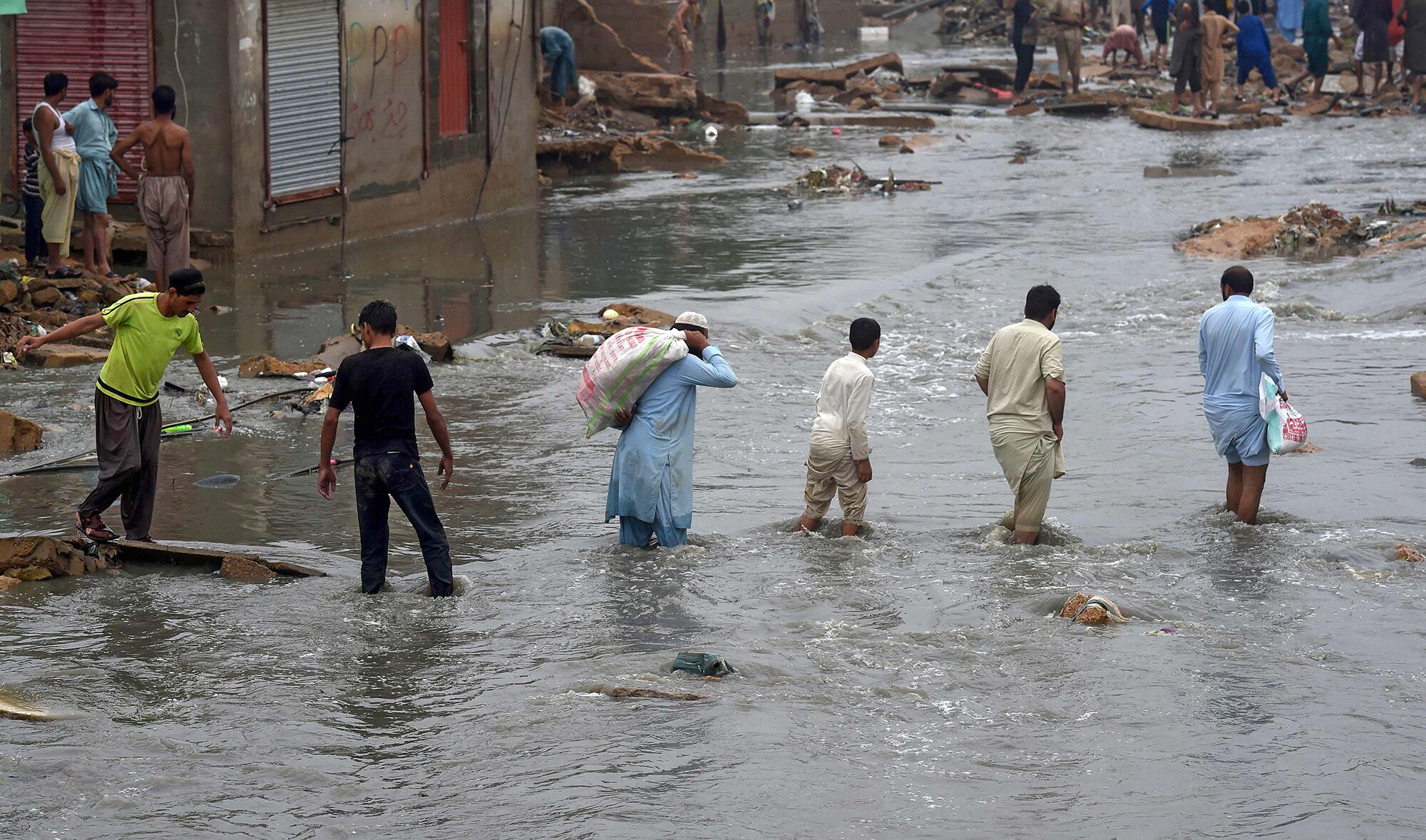
Web Desk (LTN NEWS): The newest evidence estimates that economic losses and damages caused by the flash floods could range from $15 billion to $20 billion, as the government worries up to 12 million more people would slip into poverty, highlighting the need for immediate and large global financial help.
The economic losses are significantly higher than the early projections of $10 billion to $12 billion, according to a Ministry of Finance assessment.
There are direct $12 billion losses to the economy, $6 billion in damages to the housing infrastructure, and $4 billion were the cost of animal losses.
“We have increased our prior estimates of the economic losses to $15 billion to $20 billion in light of fresh information,” said Dr. Aisha Pasha, the Minister of State for Finance who oversaw the exercise.
The analysis also highlighted that the floods might further increase the trade imbalance by $4 billion and the additional impact on the current account deficit is also predicted in the range of $4 billion to $5 billion.
As to earlier forecasts of still achieving over 2% Gross Domestic Product (GDP) growth, the new estimates give that the growth rate may slide to below 2%. The GDP growth for the fiscal year 2022-23 is predicted to remain between 1.8-2.3%, according to the research.
Read: Floods in Pakistan cause damage of $10b
The early analysis suggested that the entire loss in the growth of GDP will be 2.8% to 3.3% due to floods.
On the other side, imports of raw cotton, wheat, pulses, sugar, construction gear, and medications may increase.
The cotton, rice, maize, and sugarcane are largely damaged by the flood and their growth is predicted to be negative by 14% to 15.4%. The growth in other crops is also anticipated to be negative by up to 15%.
The growth in livestock is predicted to stay at 2% to 3%. The loss in the growth of the agriculture sector will be 3.5% to 4.5% and its growth may be negative by up to 2.1% for the present year.
The Food and Agriculture Organization (FAO) early estimates imply that over 4.5 million acres of cropland have been impacted by the recent floods increasing the risk of food insecurity. Only in Sindh 3.5 million acres of crops are devastated by the floods, contributing 78% of the overall losses. In Punjab, crops standing at 639,000 acres of land were impacted.
The loss in the growth of the industrial sector will be 3.5% to 4%. Its growth for the current fiscal year is predicted to be 1.9% to 2.5%. The decrease in growth of the services sector will be 1.8% to 2.3%. Its growth for FY 2023 is predicted to stay at 3.5%.
The Finance Ministry’s preliminary assessment revealed that the confirmed deaths due to the floods include more than 1,325 deaths, over 13,000 injuries, and over 1.7 million dwellings damaged or destroyed.
The damages to housing infrastructure are estimated at $6 billion. Out of 1.7 million damaged units, as much as 1.5 million are in Sindh, followed by 87,772 in Khyber Pakhtunkhwa and 63,068 in Balochistan. In Punjab 59,000 dwelling units are predicted to be destroyed by the floods and 1678 in Gilgit Baltistan and Azad Kashmir.
Another $4 billion losses are expected on account of animals. The study found that 750,000 animals have been lost, 5,735-kilometer highways, and 246 bridges have been destroyed.
In the power industry, initial estimates reveal that at least Rs3.3 billion are necessary to get things operating again, although the true assessment of damage would only be evident once access is restored to all locations.
Sindh and Balochistan have sustained the biggest losses. In Sindh, 554 transformers, 486 High tension structures, and 47 civil structures were destroyed, costing Rs1.6 billion.
As per the NDMA report of 5th, September 2022, the roadways infrastructure is hampered due to the floods in Balochistan.
The Railway network in Pakistan is damaged by the floods, especially the railway track between Quetta to Taftan in Balochistan and Quetta to Sibbi to Habib Kot from Balochistan to Sindh. The track connecting Punjab to Sindh from Hyderabad to Rohri to Multan is also closed due to floodwater.
In Sindh, the route from Kotri to Lakhi Shah to Dadu is also interrupted.
The floods have destroyed multiple health facilities across impacted areas, including 501 health facilities in Sindh (including 88 entirely), and 244 health facilities in Balochistan